

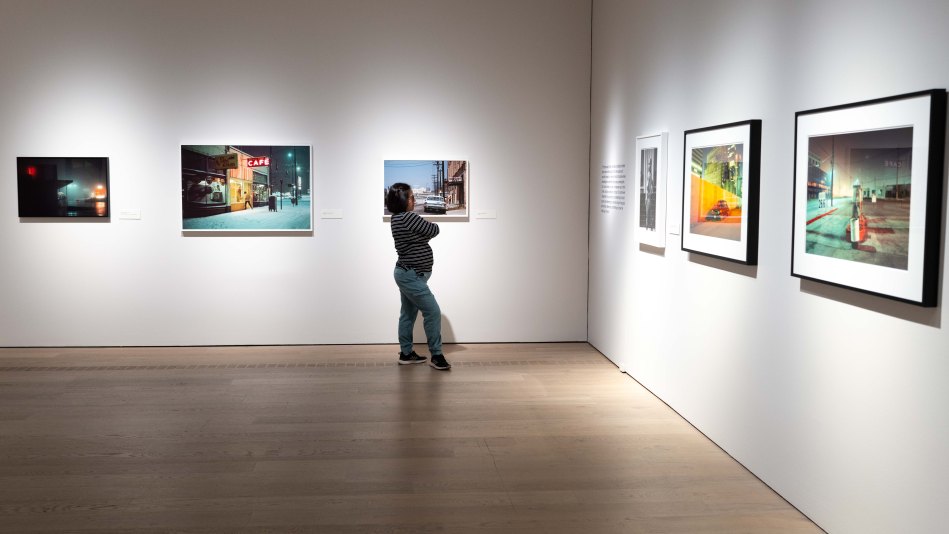
Part 2 of a series on Vancouver photographers. You can find Part 1 of this series, An Appointment with Fred Herzog, here.
Greg Girard (born 1955) is a Canadian photographer, best known for his prolific published work examining social and physical transformations in some of Asia’s big cities, such as Hong Kong, Shanghai, and Tokyo. His earlier, but later-published work depicts the streets of his home city, Vancouver, in the 1970s and early 1980s.
Girard lived and worked in various cities in East and Southeast Asia from the 1970s until 2011, including Tokyo, Hong Kong and Shanghai. He was head photographer with Asiaweek and freelanced with other magazines. He returned to live in the Vancouver area (Surrey, BC) in 2011. In 2026, the Polygon Gallery in North Vancouver held the first major retrospective exhibition of his work. It reveals an empathetic, compassionate mind behind the camera, making visually impactful social documentary pictures over a career spanning more than five decades.
Pre-Bubble City
One of Girard’s best-known images is “Platform Conductor” (1976), taken at Ikebukuro Station, Tokyo, on his first visit to Japan’s capital city. He planned to stay just a few days because it was so expensive for a 21-year-old traveller, but decided to stay longer. Girard lived in the massive metropolis from 1976-77 and 1979-80, sometimes teaching English by day and photographing the streets at night (Bright, 2024).
I spent the first night walking and photographing all over the city.
Greg Girard (n.d.)
By morning I knew I had to stay.
Girard said: “I spent the first night walking and photographing all over the city. By morning I knew I had to stay. The photographs in JAL 76-88 [his publication] are artifacts of a pre-bubble Japan, and particularly Tokyo, before the term “BladeRunner-esque” became the default for a neon-soaked, urban Asia-influenced near future.” (Girard, n.d.).
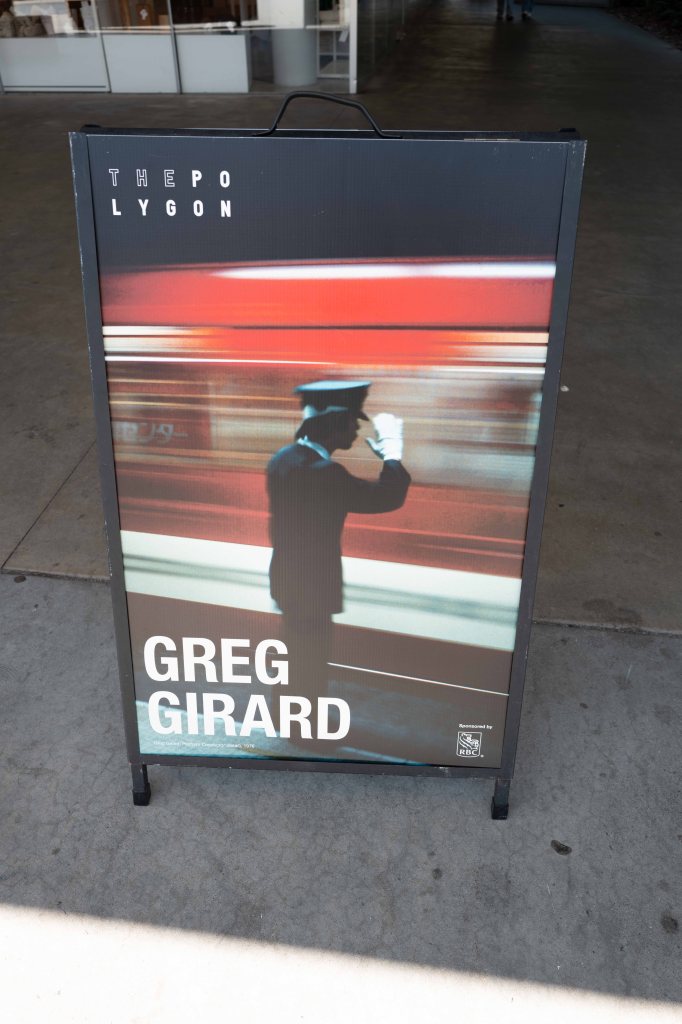
Display board featuring Greg Girard’s Platform Conductor (1976) outside The Polygon Gallery, North Vancouver, BC, Canada.
Kowloon Walled City
Hong Kong was the first place in Asia that Girard visited, travelling by freighter from San Francisco. In subsequent visits, he worked as a sound recordist for the BBC and officially began living there in 1983.
Photographing what is not even
visible to the naked eye.
He says, “To a large extent I carried on photographing the way I’d been photographing in Vancouver: the ordinary, unglamorous parts of the city at night using long exposures to create a kind of charged and elevated take on what is usually overlooked or not even visible to the naked eye” (Polygon Gallery, 2026).
He co-authored two books with photographer and architect Ian Lambot about the Kowloon Walled City, a densely populated, unregulated community in Hong Kong known locally by its Cantonese name, Hak Nam, or the “City of Darkness.” Although the city was demolished in 1993 and turned into a public park, its former kakatopian existence lives on in a second life as a representative of anarchic urbanism in films such as Ridley Scott’s “Blade Runner” (1982) (my favourite sci-fi film) and Christopher Nolan’s “Batman Begins” (2005), in which it influenced the slum called The Narrows in Gotham City.
The original “City of Darkness: Life in Kowloon Walled City” was published in 1993, based on four years of exploration by the two photographers. Their images were accompanied by essays featuring interviews and oral histories with more than 30 residents, workers and business owners conducted by Emmy Lung.
Twenty years later, the authors decided to bring the story of Hak Nam up to date. Numerous images not used in the original edition were added, together with essays on the City’s history, development and influence on popular culture in Hong Kong and around the world (Lambot, n.d.). City of Darkness Revisited was published in 2014. Girard describes it as “the most thorough record of the Kowloon Walled City, one of Hong Kong’s most notorious, and most misunderstood, neighborhoods. While it stood it was the most densely populated place on the planet: over 35,000 people squeezed into 350 buildings, 12-14 floors high, packed into a single Hong Kong city block.”
In spite of its preposterous physical properties, it was a place inhabited by people working and trying to raise families.
Greg Girard (Polygon Gallery, 2026)
Girard was empathetic towards the community living and working in Kowloon Walled City. “I started visiting and photographing there, quickly discovering that it was nothing like its reputation for drugs, gangs, gambling, and danger, but rather, in spite of its preposterous physical properties –buildings seemingly built on top of buildings, alleys with elongated nests of piping and electrical wiring overhead, animal carcasses next to gutters running with god knows what – it was a place inhabited by people working and trying to raise families. And so I started to photograph people using the lighting techniques I’d learned in order to make portraits for Fortune and Time Magazine of CEOs and celebrities, rather than portray the place in a noir-ish, gritty, sensational faux-documentary manner. Using lighting equipment actually helped win folks over in the sense that it was clear I wasn’t sneaking around, but rather spending time to make a picture, and requiring people’s permission to do so.” (Polygon Gallery, 2026).
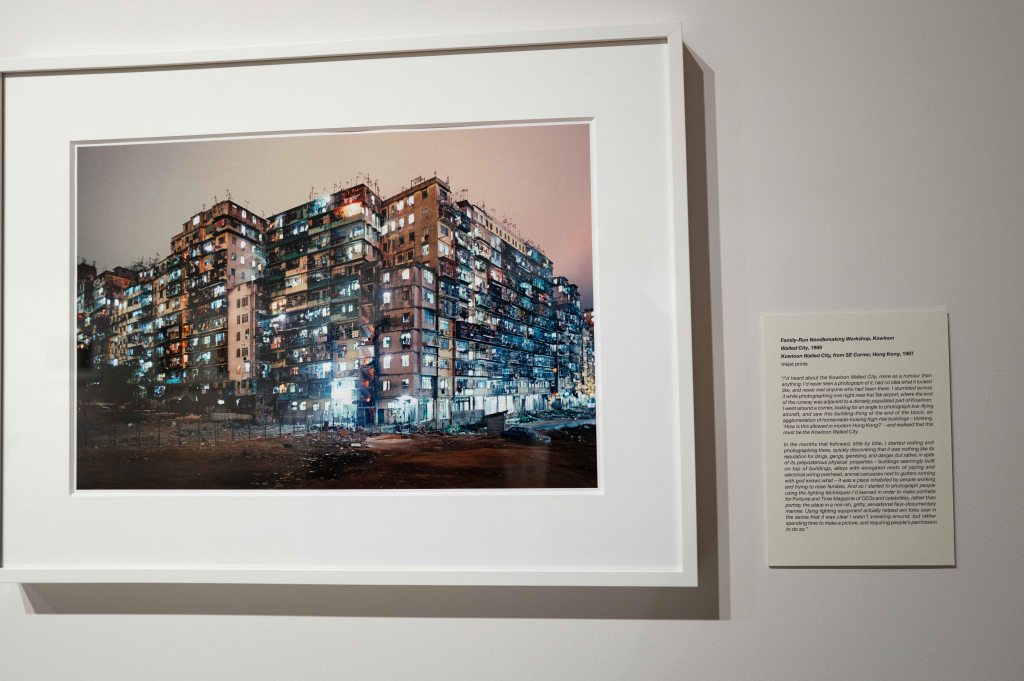
Kowloon Walled City, from SE Corner, Hong Kong, 1987. © Greg Girard [photograph displayed at the Polygon Gallery, 2026]
Phantom City
Girard worked and lived in Shanghai between 1998 and 2011. Around 2000, he decided to move out of commercial magazine work and focus on his own projects and books.
I wanted to make pictures of what I was seeing around me that didn’t necessarily fit into the framework of a magazine’s needs and certainties.
Greg Girard (Polygon Gallery, 2026)
In explaining this move, he said: “Magazine pictures accompanied magazine stories, and frankly illustrated them and their point of view. I went at that whole-heartedly in the beginning, but after a decade or so that was starting to play itself out. There’s an obviousness to those sorts of pictures, a point of view that is considered successful if it’s in lockstep with the headline. I wanted to make pictures of what I was seeing around me that didn’t necessarily fit into the framework of a magazine’s needs and certainties.” (Polygon Gallery, 2026).
His book “Phantom Shanghai” (2007) documents Shanghai’s dramatic, rapid urban transformation as the city said goodbye to its early 20th-century architecture.
Without diminishing the quality of “Phantom Shanghai”, the suggestion (on Girard’s website, by the Monte Clark Gallery, which represents him and his 2026 Polygon Gallery/Magenta Foundation book) that the UK’s newspaper The Independent cited Phantom Shanghai as one of the top ten photographic books ever produced could not be verified by my online search.
West Coast City
The pictures in “Under Vancouver 1972-1982” were made before and after Girard’s first trips to Japan, Hong Kong and SE Asia. They reveal the look and feel of a place economically fed by timber sawmills, rail yards, and an industrial port; fifty years later, it looks very different, with a persona as one of the world’s most liveable cities (but also with ongoing concerns over safety, drug use, homelessness, poverty and other social issues in the Downtown Eastside area).
He began the series as a 16-year-old high school student in Burnaby, for a school assignment. He would bus it into downtown on weekends, sometimes staying overnight in cheap hotels so he could photograph people in cafés and pool halls, pawn shop windows, streets, and cars around Vancouver’s waterfront, often at night.
I could stay in a cheap hotel and by doing so cross an invisible boundary and enter the world of people who lived downtown.
Greg Girard (Polygon Gallery, 2026)
Girard said, “I was too young to go to bars but somehow the idea occurred to me that I could stay in a cheap hotel and by doing so cross an invisible boundary and enter the world of people who lived downtown, the ones I’d been photographing in pool halls and cafés and in the streets. Hotel rooms seemed adult and mysterious and charged with the energy of people who had passed through them before me.” (Polygon Gallery, 2026).
He experimented with a variety of film stocks (listed at the back of his book), including colour transparency (slide) film (Kodachrome, Ektachrome, and Fujichrome) and Kodak Tri-X for black-and-white prints, to show “Vancouver’s final days as a port town at the end of the rail line.” (Girard, n.d.)
The series continued when Girard returned from Tokyo to Vancouver in 1980. As a taxi driver, he gained access to many locations around the waterfront at night (Arden, 2026).
There’s something unguarded and direct about these pictures.
Greg Girard, 2017
“Under Vancouver” includes an extended dialogue between the photographer and David Campany. “Looking at these early Vancouver pictures now, there’s something unguarded and direct about them”, says Girard, who continues: “I had no idea at the time that they would ever be seen, or that I would ever figure out how to have some sort of life as a photographer. But beginnings are like that, I suppose. You have no idea what you’re doing, and you just plunge ahead, trying to distill everything around you and within you, while avoiding thinking too much about the seeming impossibility of it going anywhere.” (Campany, 2017).
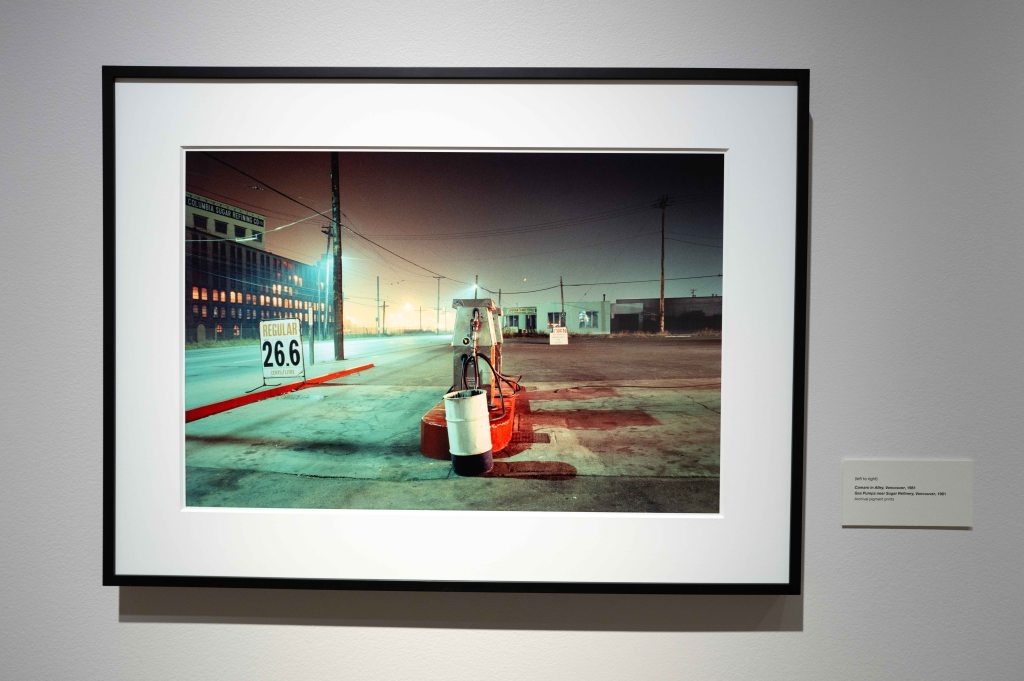
Gas Pumps near Sugar Refinery, Vancouver, 1981. © Greg Girard [photograph displayed at the Polygon Gallery, 2026]
Polygon Photos
Greg Girard has published eight photo books in English as an author or co-author. Bookmaking was something he always wanted, the photographer said in an interview. “[It’s] something that still excites me quite a lot” (Drummond 2026). Surprisingly, his show at The Polygon Gallery in North Vancouver (July 10 – Oct 25, 2026) was his first ever public career survey.
Wall display at the Polygon Gallery, 2026.
I visited his exhibition in August. Comprising over 160 images and spanning a career of 54 years, the show offers many examples of urban nighttime, some with the gaudy, highly saturated neon lights that his work is often associated with. But there are portraits there, some in monochrome, others capturing colourful or shadowed figures at tram stops and curbsides; artifacts of urban living, such as “Three White Shirts, Vancouver 1981”; and examples of the front covers and photo-essay spreads he earned a living from with Asiaweek, International Business Week and other magazines.
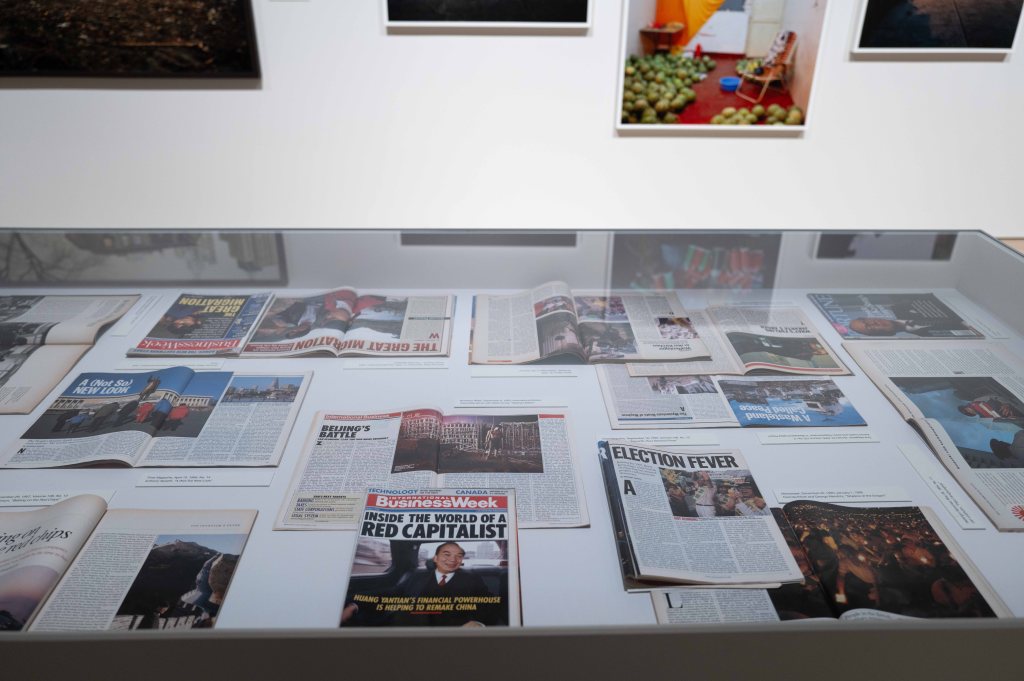
Photo essay spreads and front covers. © Greg Girard [photographed at the Polygon Gallery, 2026]
The exhibition, curated by Reid Shier and Elliott Ramsey, runs in a loosely chronological order from his first photography in Vancouver in 1972, through his time in Japan (1976-88), Hong Kong (1982-98) and Shanghai (1998-2011) before closing with recent work up to the current year.
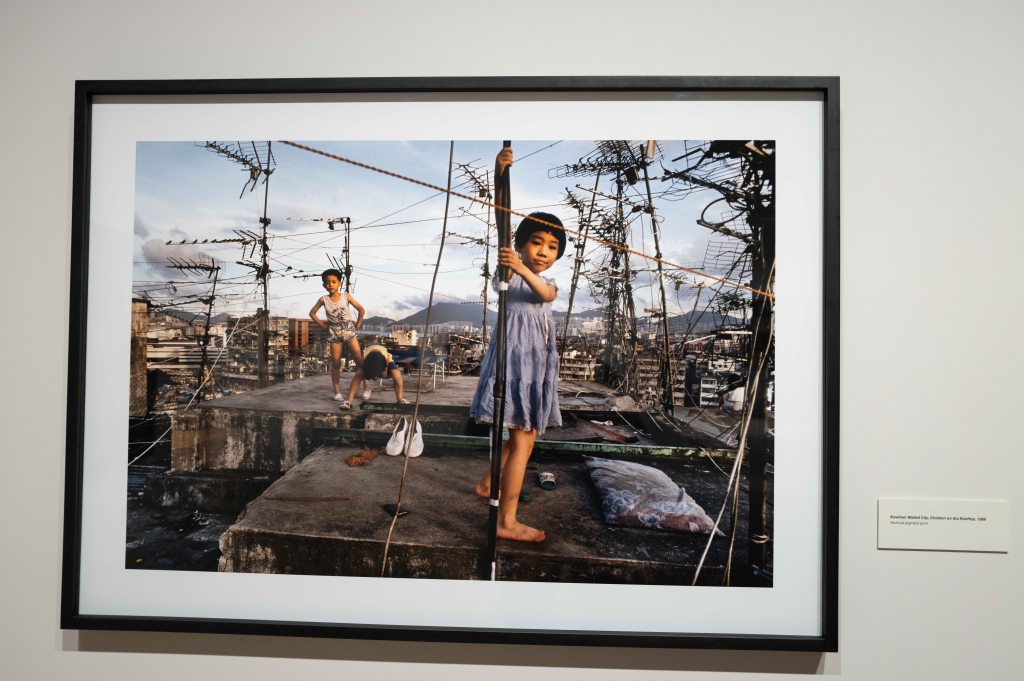
Kowloon Walled City, Children on the Rooftop, 1989. © Greg Girard [photograph displayed at the Polygon Gallery, 2026]
Scrumptious Greens
Within this time trek, there are some beautiful juxtapositions and transitions. My favourite is a diptych that starts on the left with a green-hued nighttime view of a Sunakku (Japanese snack bar) on Shikoku, the smallest of the country’s four main islands: “‘Sakura’ Sanbonmatsu, Shikoku, 2022”. On the right is a portrait of the Mama-san of another of these traditional drinking places, wearing a green coat. She is in her snack bar in the former city of Mizusawa in Iwate Prefecture, northern Japan; the photograph is called “Snack Owner Mizusawa Iwate, 2023”. Scrumptious greens! (As an aside, Los Angeles Dodgers combo batter and pitcher Shohei Ohtani is from Mizusawa, which merged into the city of Ōshū in 2006.)
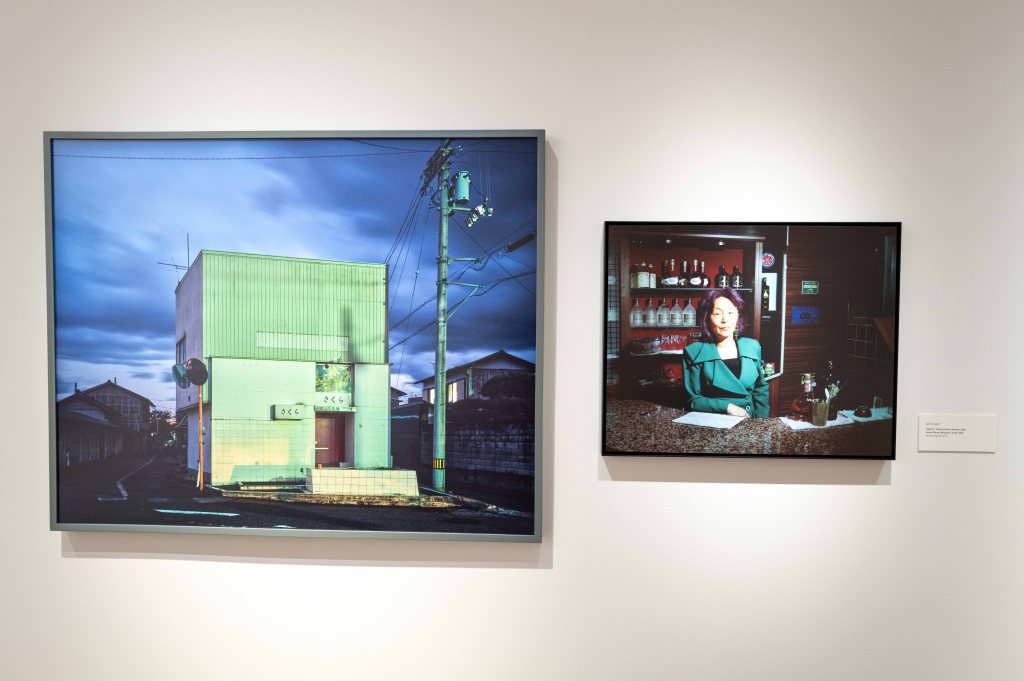
‘Sakura’ Sanbonmatsu, Shikoku, 2022 (left) and Snack Owner Mizusawa Iwate, 2023. © Greg Girard [photographs displayed at the Polygon Gallery, 2026]
Roy Arden, 2026
A Compulsive Photographer
The companion book “Greg Girard: Photographs 1972-2026” is co-published by The Magenta Foundation and The Polygon Gallery (2026). Jointly, the book and exhibition cover just a representative fraction of the work of Greg Girard, who his friend and photographer, Roy Arden (2026), has described as a “compulsive photographer [who] has made more photographs of more subjects than he, or anyone, will probably ever be able to fully sort through”.
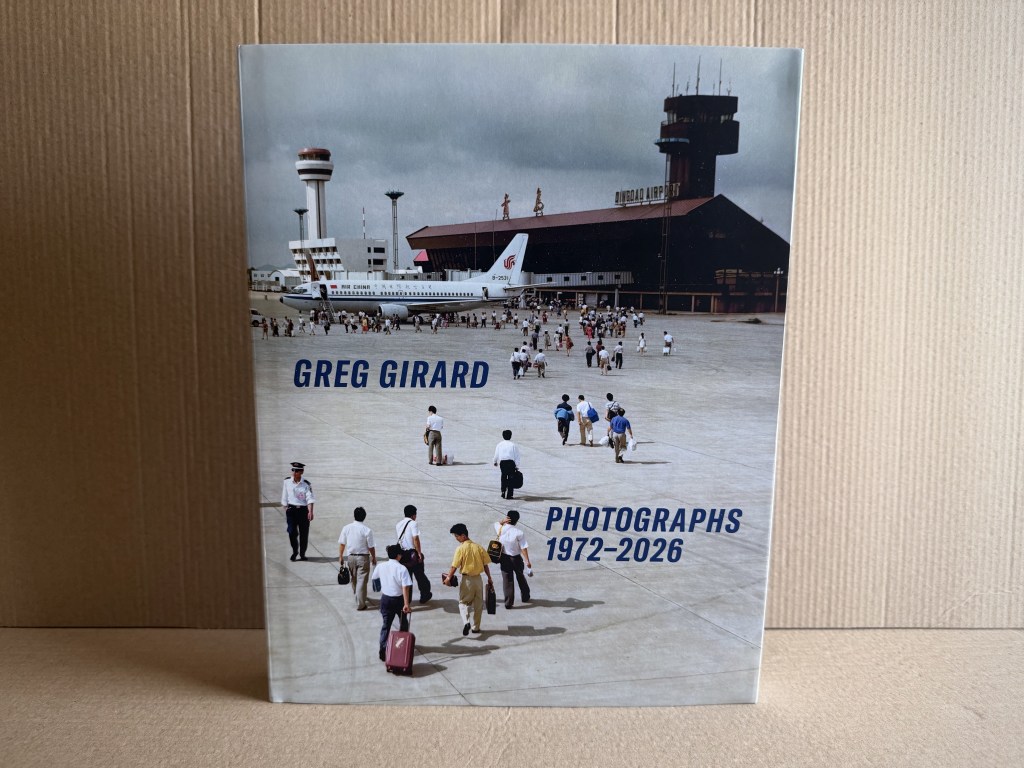
Front cover of the companion book to the Greg Girard exhibition (Polygon/Magenta Foundation, 2026).
Other Photographers from Vancouver
You can find Part 1 of this series, An Appointment with Fred Herzog, here.
References
Arden, R. (2026). Greg. In: Greg Girard: Photographs 1972-2026. The Magenta Foundation, Toronto and The Polygon Gallery, North Vancouver.
Bright, J. (2024). Greg Girard: The Colourful Night. The Independent Photographer. Retrieved October 26, 2026, from https://independent-photo.com/news/greg-girard-the-colorful-night/
Campany, D. (2017). Greg Girard and David Campany in Conversation. In: Girard, G. (2017). Under Vancouver 1972-1982. Magenta Foundation, Toronto. Retrieved October 26, 2026, from https://davidcampany.com/greg-girard-david-campany-conversation/
City of Darkness Revisited (n.d.). City of Darkness Revisited Website. Retrieved October 26, 2026, from https://cityofdarkness.co.uk/
Drummond, J. (2026). The Long Exposure: Photographer Greg Girard’s Hidden Vancouver Finally Comes Into Focus. Vancouver Magazine. Retrieved October 26, 2026, from https://vanmag.com/city/arts-and-culture/canadian-photographer-greg-girard-career-exhibition/
Economist Intelligence Unit (2026). EIU Global Liveability Index 2026. Retrieved October 26, 2026, from https://www.eiu.com/n/wp-content/uploads/2026/07/EIU_Liveability-Index-2026.pdf
Fraser, A. and Cheuk-Yin Li, E. (2017). The Second Life of Kowloon Walled City: Crime, Media and Cultural Memory. Crime Media Culture 13 (2), 217-234. Retrieved October 26, 2026, from https://pmc.ncbi.nlm.nih.gov/articles/PMC5732597/
Girard, G. (n.d.). Greg Girard. Retrieved October 26, 2026, from https://www.greggirard.com/
Girard (n.d.). City of Darkness Revisited. Retrieved October 26, 2026, from https://greggirard.bigcartel.com/product/city-of-darkness-revisited-with-signed-limited-edition-8×10-inch-print
Girard, G. (n.d.). Under Vancouver 1972-1982. Retrieved October 26, 2026, from https://greggirard.bigcartel.com/product/under-vancouver-1972-1982
Nixon, J.A. (2019). Blade Runner: The Future is the Past. Retrieved October 26, 2026, from https://nixonscan.com/2019/11/01/blade-runner-the-future-is-now-the-past/
Polygon Gallery (2026). Greg Girard: Photographs 1972-2026 [Exhibition]. The Polygon Gallery, North Vancouver, BC, Canada.
Polygon/Magenta Foundation (2026). Greg Girard: Photographs 1972-2026. The Magenta Foundation, Toronto and The Polygon Gallery, North Vancouver.


Pingback: An Appointment with Fred Herzog – NixonScan