

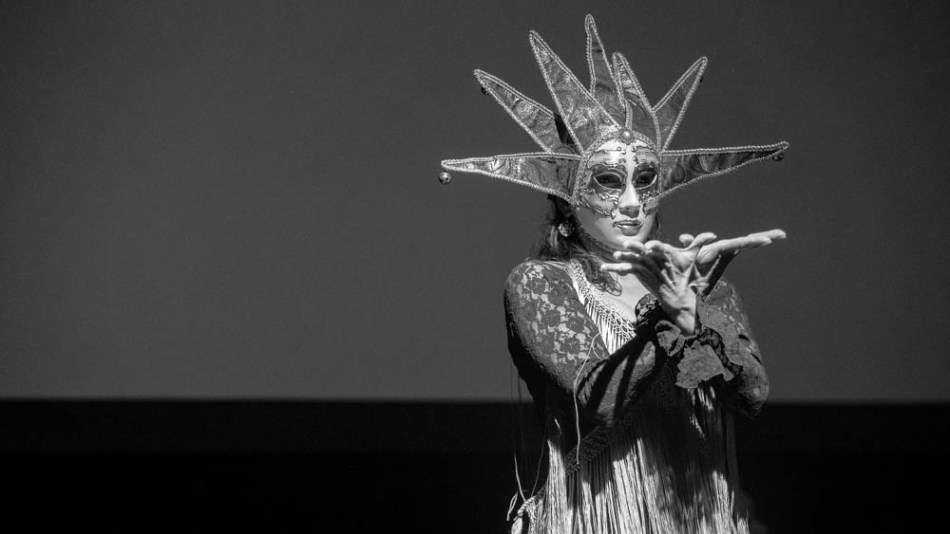
Flamenco and Venice. A dance with singing and guitar from the south of Spain and an Italian city famous for its architecture, canals and gondolas. Linking them together might, at first glance, make a curious pairing, but look further, and some potent artistic and cultural connections can be found. Both are recognized by UNESCO for their heritage values. Venice and its Lagoon has been a World Heritage site since 1987 “in recognition of its unique historical, archaeological, urban and artistic heritage and exceptional cultural traditions, integrated into an extraordinary natural landscape.” (UNESCO 2014). Flamenco was recognized by UNESCO for its intrinsic cultural heritage in 2010, saying: “It is strongly rooted in its community, strengthening its cultural identity and continuing to be passed down from one generation to the next.”
Berlin-based bailaora Fiona Malena and Calgary artist Paul Van Ginkel did their research, made some visits and came up with the fusion concept of Barcarolle, which recently performed at cSPACE Marda Loop in Calgary, Canada. It featured the powerfully percussive dancing of Fiona and Anastassiia Alexander, accompanied by the beautiful voice of singer Silvia Temis, and the elegant guitar playing of Jake “El Chinito” Lee (who also had a singing solo) and Michael Boyle.
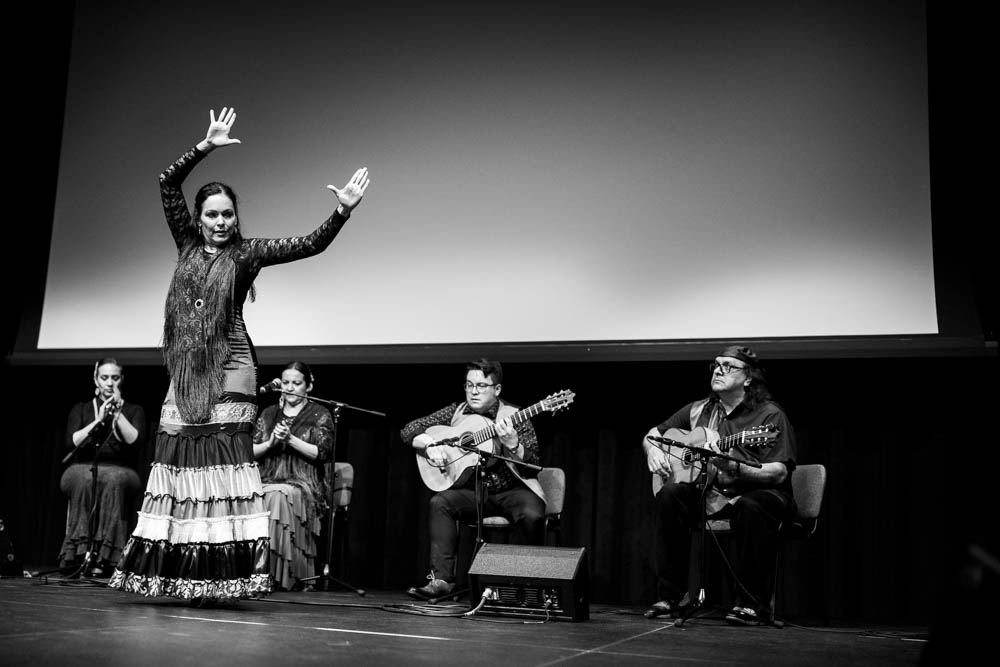
Barcarolle performed by (left to right): Anastassiia Alexander, Fiona Malena, Silvia Temis, Jake Lee and Michael Boyle. © J. Ashley Nixon
What’s in a name?
The show’s name comes from folk songs known as barcarolles sung by Venetian gondoliers as they single-handedly propel their vessels (barcas) filled with tourists under the Rialto Bridge, around the canals, and into the lagoon. Barcarolles are also found in classical music, notably Jacques Offenbach’s opera The Tales of Hoffman and a series of thirteen barcarolles written for piano by Gabriele Fauré. The timing and feel of their melodies are suggestive of the rocking of the gondolas and the lapping of the water.
Creating the concert
I asked Fiona how the concept for the dance performance evolved. “The idea of a flamenco concert infused with the theme of Venice came naturally from the artist Paul Van Ginkel”, she said, explaining that Paul had initially painted scenes in Venice and (separately) flamenco dancers, including herself. He came up with the idea of bringing these two themes together in 2016. Fiona made four visits to Venice, the last one in February 2024, to have photographs made of her dancing and to explore the canals, alleyways, secret doorways and bridges that were “highly inspirational” to her as she gathered ideas and concepts for the performance.
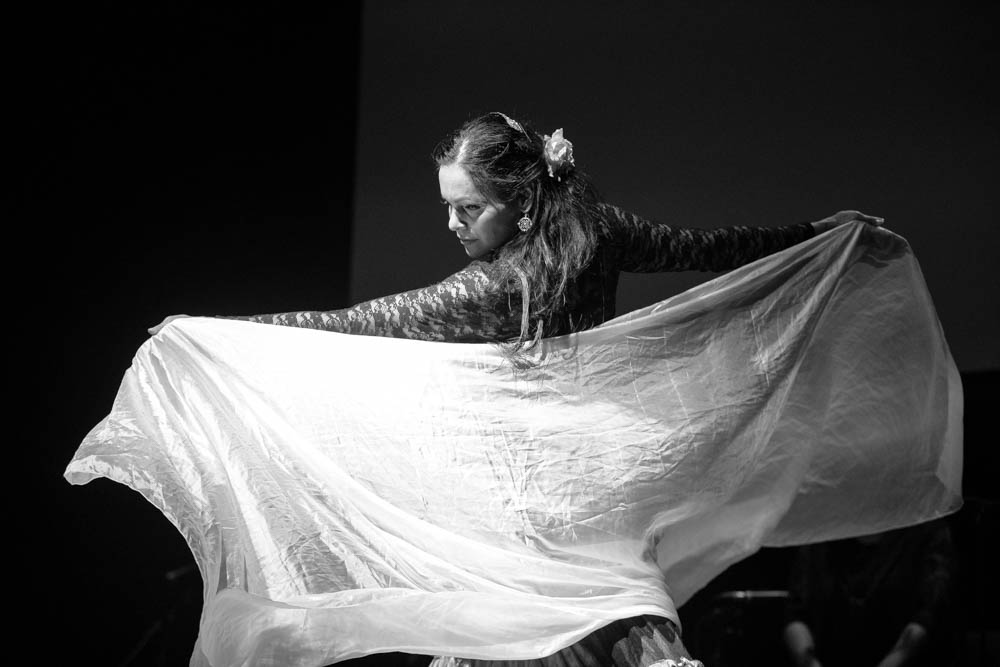
In the opening half of the show, the two dancers used large swaths of chiffon and silk as they intertwined and moved around the stage, promoting the concept of water that is central to Venice’s life and existence. The choreography created waveforms, fluid extensions of the traditional use of mantoncillos (shawls) in flamenco. Although the stage lighting was in the blue spectrum, I couldn’t help thinking about (and looking for!) the shape-shifting red coat that suddenly appears and disappears from the Venice scenes of Don’t Look Now, the hauntingly beautiful film (1973) directed by Nicolas Roeg and starring Julie Christie and Donald Sutherland.
Masked dancers
In the second half of Barcarolle, the dancers wear masks during a theme of “transformation.” Their use was inspired by the masks associated historically with the aristocracy of old Venice, who would wear masks during certain times of the year, including the Venice Carnival to go out socializing without their identities being revealed. Some masks were quite plain, made from papier mâché, painted white, and made to resemble (but not imitate) the contours of the wearer’s face.
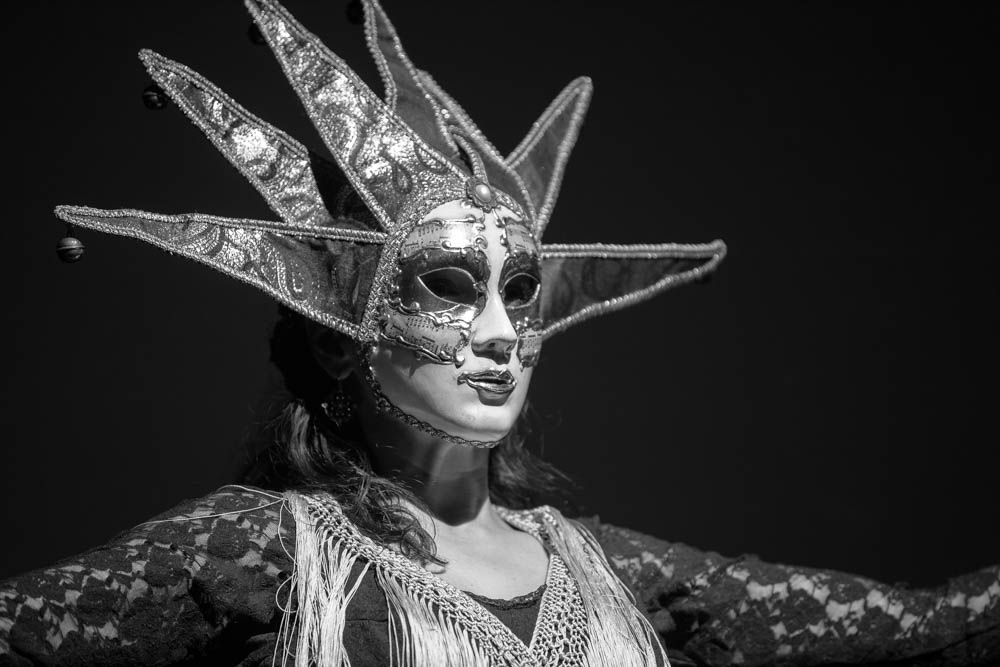
Barcarolle performed by Fiona Malena. © J. Ashley Nixon
Others, like the one worn by Fiona, were more elaborate and used for carnival time. A third type of mask came from characters in theatrical performances. Pantalone is an old man whose mask has large eyebrows and a beaked nose. Pierrot is a sad clown whose mask is white with a black teardrop. The Harlequin has a half mask, as does his female counterpart, Colombina, such as the one worn by Anastassiia in the performance.
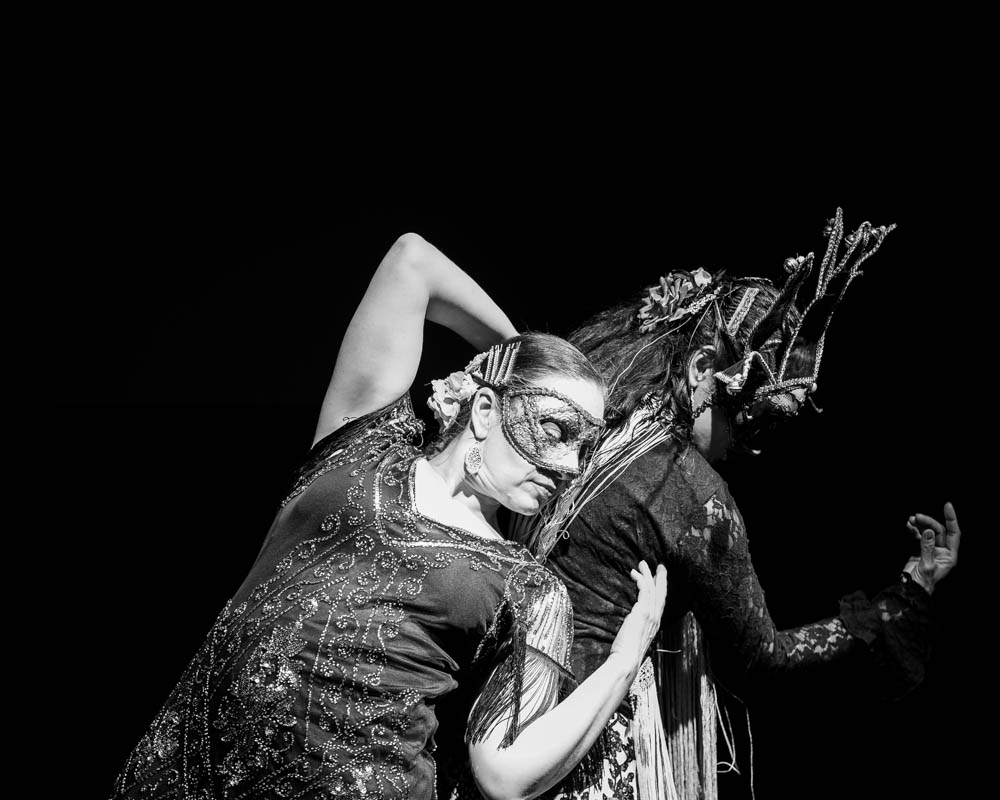
Barcarolle performed by Anastassiia Alexander (left) and Fiona Malena. © J. Ashley Nixon
Ordinary people transform into the extraordinary in the Carnival.
By coincidence, one of Fiona’s research trips to Venice happened to be during Carnival, which allowed her to observe the contemporary use of masks in the city. The experience inspired her to create the transformations section of the dance. “I was fascinated to find that ordinary people could transform into the extraordinary in this brief moment of Carnival. Their costumes were lavish and detailed, full of imagination, and the person was completely covered by the disguise, even using thick black make-up around their eyes under their mask.”
“The act of putting on a mask enables you to instantly take on a different persona.”
Fiona’s own experience of using a mask in the performance of Barcarolle is fascinating: “I found that the act of putting on a mask enables you to instantly take on a different persona as well as hide many nuances of emotion while creating a whole different expression based on gesture and the tilt of one’s head for example. This transformation was fascinating to explore with dance.”
As an observer who has filmed the masked dance of the Huacones in La Huaconada de Mito, which coincidentally was inscribed as Intangible Cultural Heritage by UNESCO at the same as flamenco in 2010, I can agree with this remarkable transformation of person into character.
The music of Barcarolle
Fiona’s research also explored musical possibilities to connect Venice with flamenco. She fell in love with one of Faurés later Barcarolle’s, No. 12 in E-Flat Major and began to learn it on the piano. It has an enchanting melody with a voice from Venice. “The style of this piece and melody were incorporated into the theme of our production,” she told me. “We only focused on Fauré’s Barcarolle No. 12 as a direct musical inspiration for the flamenco arrangements.”
“Barcarolle Number 12 was composed with a rolling, waltz-like feel, which is a rhythm that fits the dance well.”
“There is a longstanding history of adapting classical piano music to guitar”, guitarist Jake Lee told me. “Flamenco and classical guitar are often described as first cousins, so the possibilities for adapting pieces for flamenco dance (baile) are numerous. Barcarolle No. 12 was composed with a rolling, waltz-like feel, which is a rhythm that fits the dance well.”
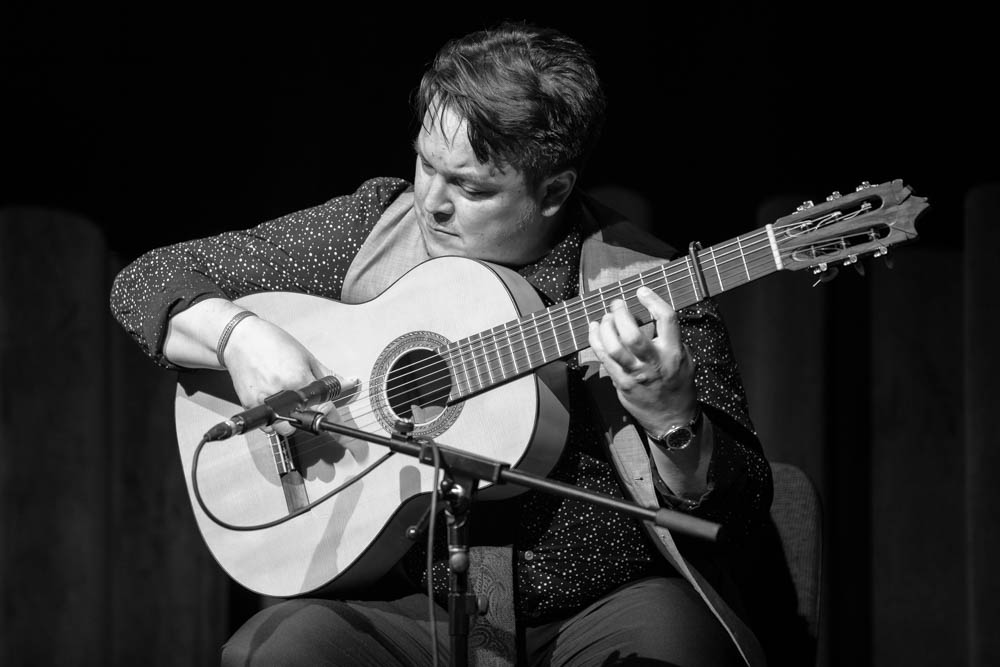
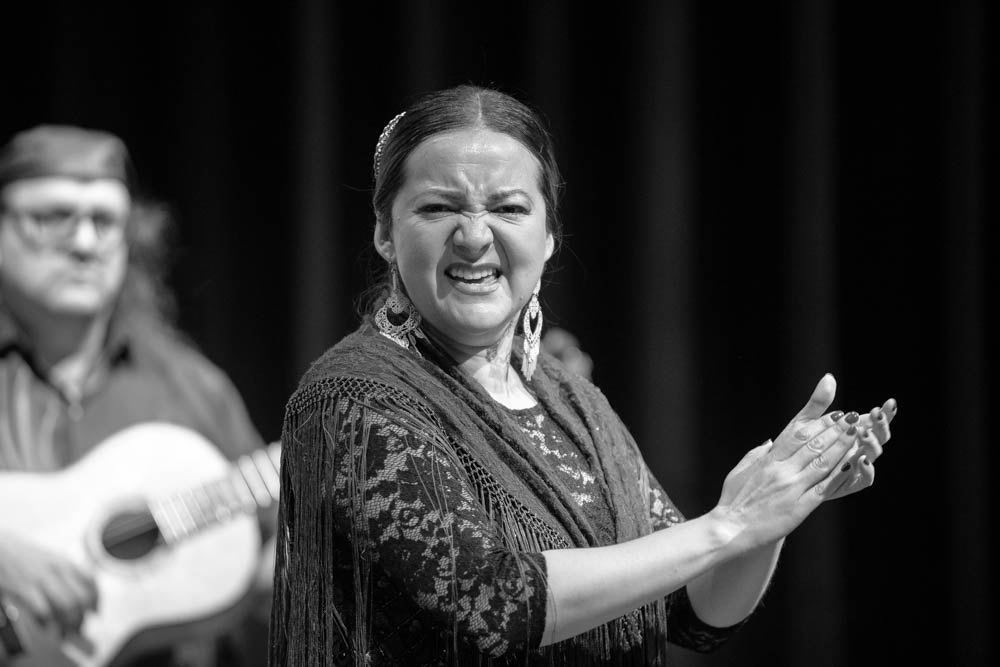
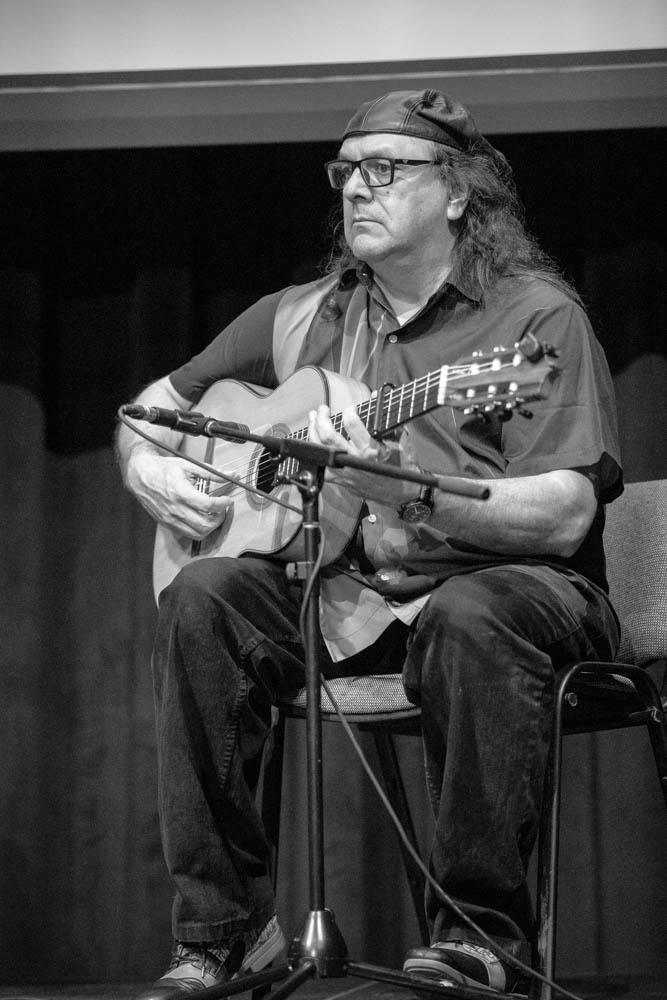
Barcarolle performed by Jake Lee (top left), Silvia Temis (bottom left) and Michael Boyle (right). © J. Ashley Nixon
Adapting the piano music for a single flamenco guitar is not easy; a second guitar was brought into the equation. “Fauré’s Barcarolle is melodically quite different from the traditional flamenco palos I’m used to,” said Jake. “Having Michael Boyle with me made things infinitely easier as his lyrical sense is so strong. Having another guitarist to play with made the process much less daunting.”
The other music in the performance was a combination of traditional and original flamenco compositions, including forms that reference water and maritime themes and music borrowed from other cultures. There were alegrías from the Spanish port of Cádiz, Guajiras from Cuba, and Colombianas from Colombia.
Dancing Barcarolle
Fiona talked about how the experience and talents of the group came together to address the challenges of dancing Barcarolle: “My first solo was an extremely difficult and dark Tarantos, which has many free rhythm sections of Taranta, and requires a very instinctive and coordinated communication between dancer, singer and guitarist. I am so grateful for the support of the two guitarists Michael Boyle and Jake “El Chinito” Lee, whose style and technique complement each other marvellously, as well as the incredibly dynamic and beautiful voice of singer Silvia Temis and the sheer power and artistry of dancer Anastassiia Alexander, who added so much to this show.”
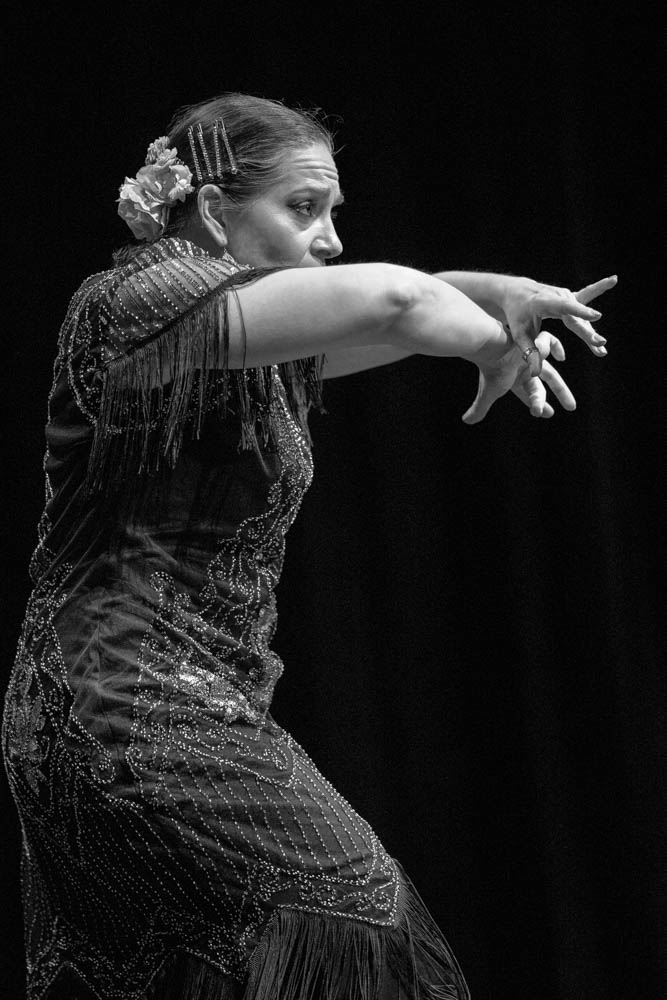
Barcarolle performed by Anastassiia Alexander (left) and Fiona Malena. © J. Ashley Nixon
Fiona also recognized Paul Van Ginkel’s pivotal role in conceiving and performing Barcarolle. “All of these artists, together with the visual direction and inspiration of Paul Van Ginkel, made Barcarolle an incredible experience.”
The Art of Dance
With nearly 2,100 paintings created so far in his 40-year career, Paul Van Ginkel’s work is in private and corporate collections worldwide. Although he is best known for his paintings of Western themes, including Indigenous subjects, he also has a strong interest in dance. A recent documentary film, Western Renaissance, directed by Jordan Geske, provides remarkable insight into his career and approach to painting. Paul has also produced a documentary film about his dance paintings in which you can see some of his earlier pieces featuring Fiona Malena.
“I’m most drawn to Flamenco because of the sheer passion, intensity, emotion and energy of the dance and music.”
I asked Paul what drew him into painting dance and the culture of flamenco. “Of all dance forms, I’m most drawn to flamenco”, he said, “because of the sheer passion, intensity, emotion and energy of the dance and music. It resonates with my very core and thus stimulates every emotional fibre within my being.
“I often say if you want to get to know a subject, paint it!”, said Paul. He has created no less than 29 paintings of Fiona Malena, two of which were on exhibition at cSPACE alongside the performance of Barcarolle. These were (at the time of writing) available for purchase together with copies from a limited edition set of fine art prints.
Below are photographs (courtesy of Paul Van Ginkel) of the two paintings of Fiona (left to right), Flamenco is the Wellspring of Passion & Beauty (60 x 40” oil painting) and A Twist of Flamenco Elegance & Beauty (60 x 40” oil painting).
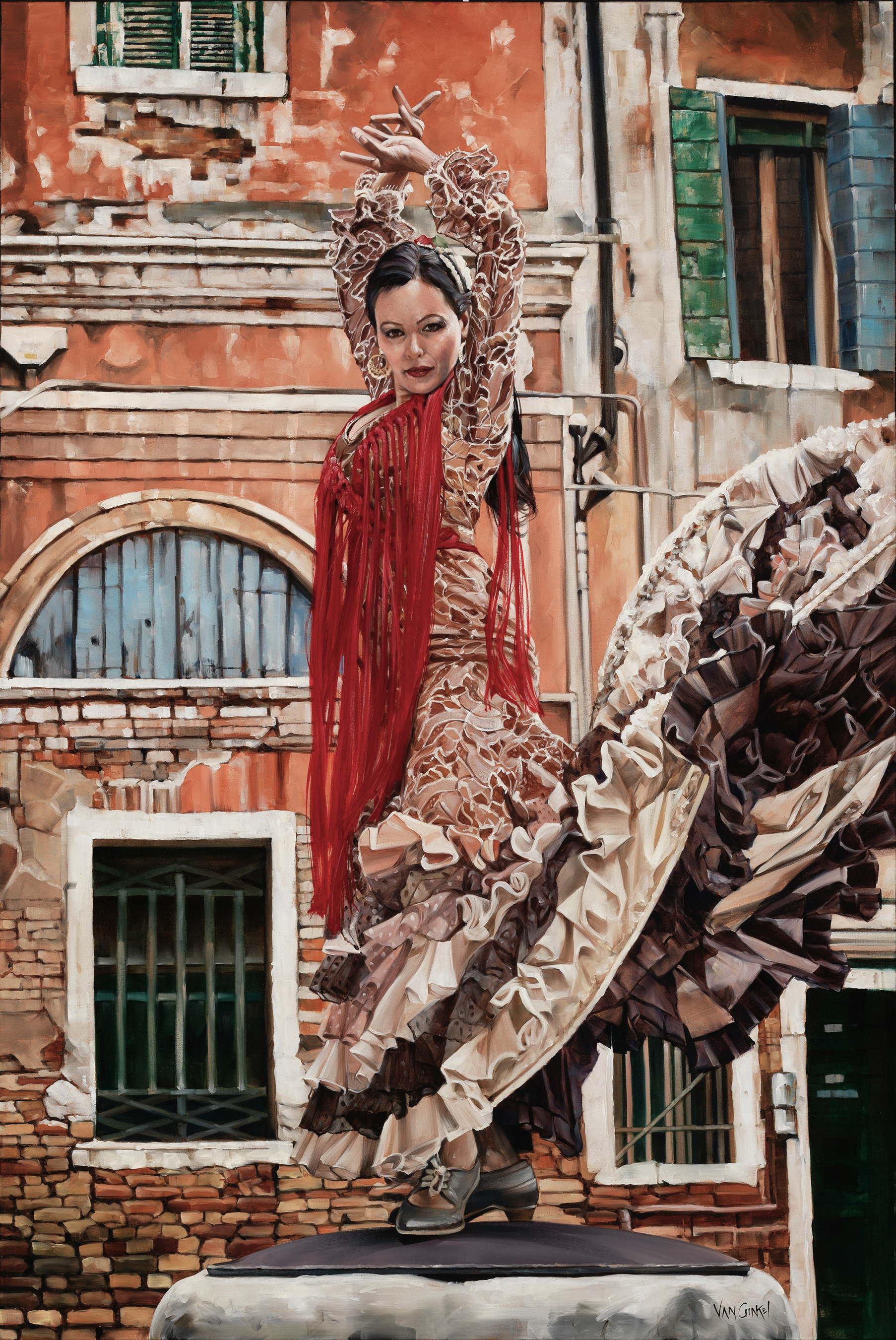
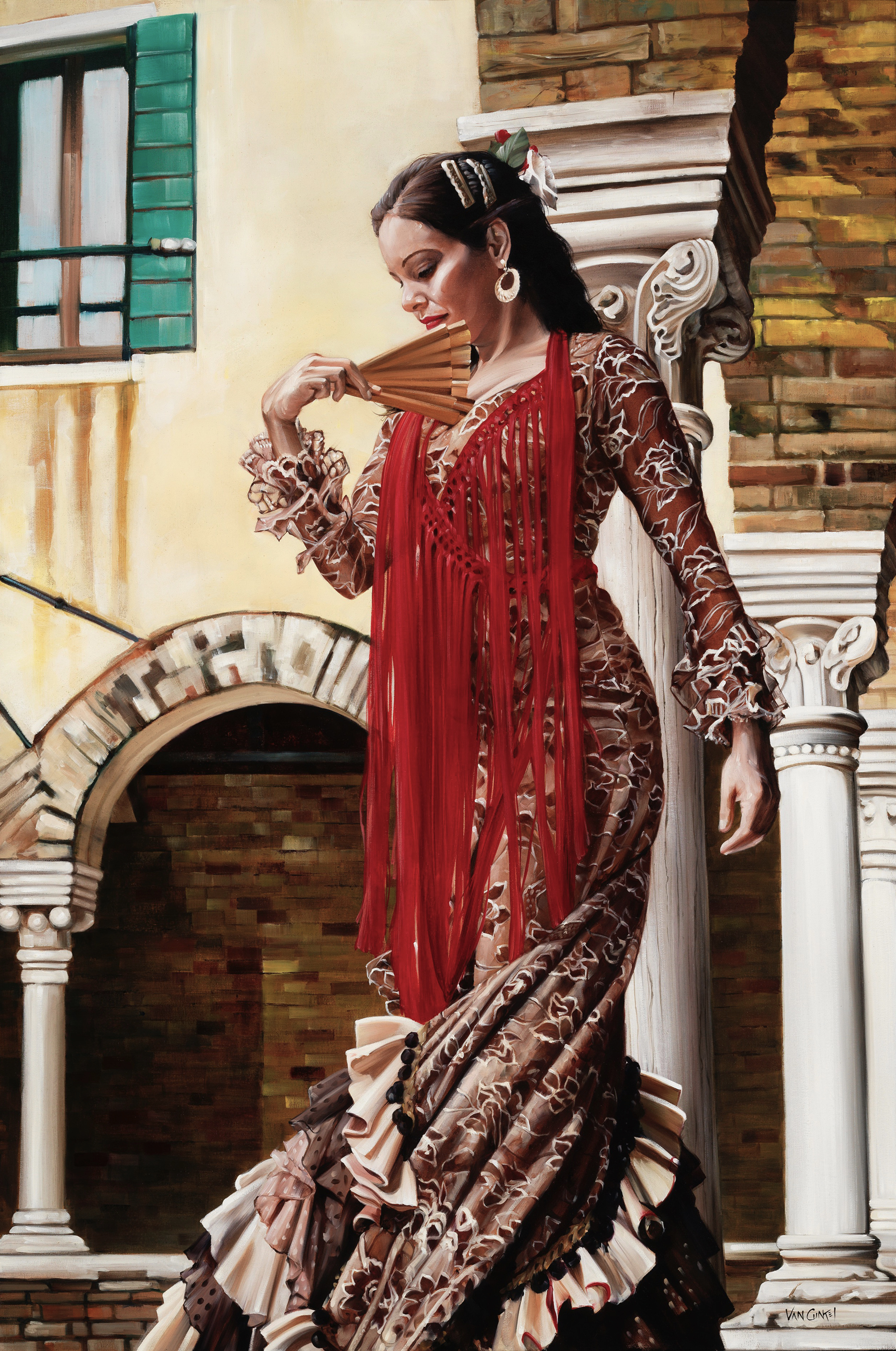
Paintings of Fiona Malena performing flamenco in Venice © Paul Van Ginkel
Fiona described how well flamenco and Venice complement one another in art and dance performance: “Connecting Flamenco and Venice in such a way is an extraordinary combination. I don’t believe it’s been done before, nor do I believe there are any other original oil paintings of a flamenco dancer in Venice other than these new pieces by Paul Van Ginkel. Somehow, the two themes of flamenco and Venice complement each other magnificently in their timeless elegance and rich artistic depth. I felt very at home in my flamenco dresses in the magical setup of Venice, balancing on the covers of old wells (as in one of the paintings), among the hanging laundry, in the silent plazas or at the water’s edge.”
Masterpieces
What was Fiona’s reaction to the paintings? “I was overwhelmed and very touched seeing his paintings live for the first time just prior to the actual performance. They are masterpieces.”
Dance Culture
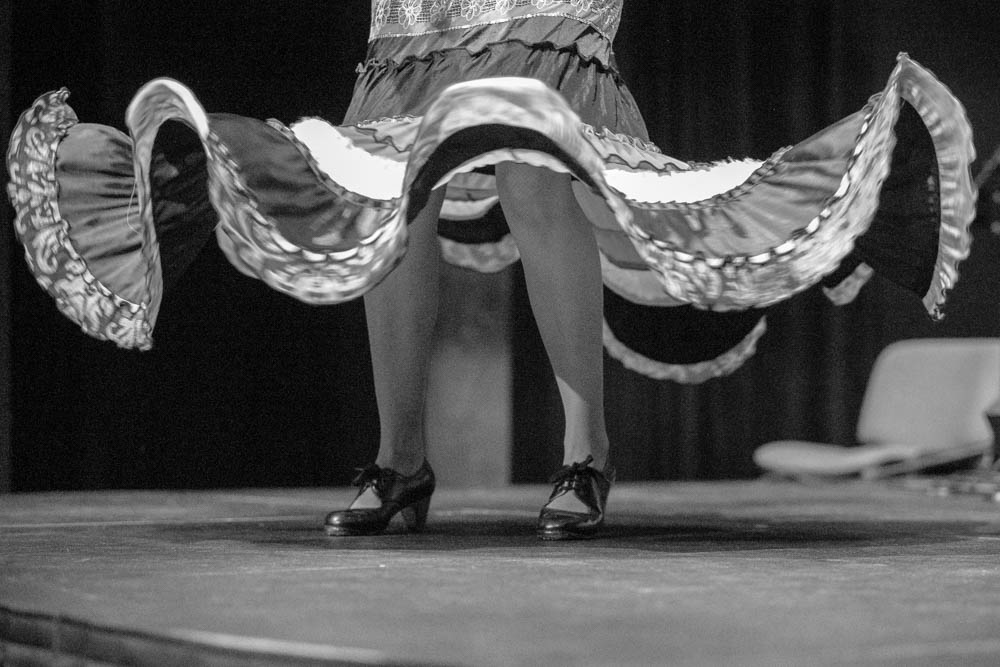
Barcarolle performed by Fiona Malena. © J. Ashley Nixon
Dance Culture, the first of my Ramifications series of short, limited-edition books, is available through Betula Books. Please visit my photo gallery for other photographs from Barcarolle and other dance performances.
 NixonScan
Pingback: Dance culture – NixonScan
Pingback: 24 pics from ’24 – NixonScan